
Learning
Letter practice
Where to find it #
Open Practice, then Alphabet & scripts. Japanese lists Hiragana and Katakana, with a link to the kanji trainer underneath. Korean lists Hangul. Each script has two ways in: Open script shows the whole chart, and Guided lesson teaches it a few characters at a time.
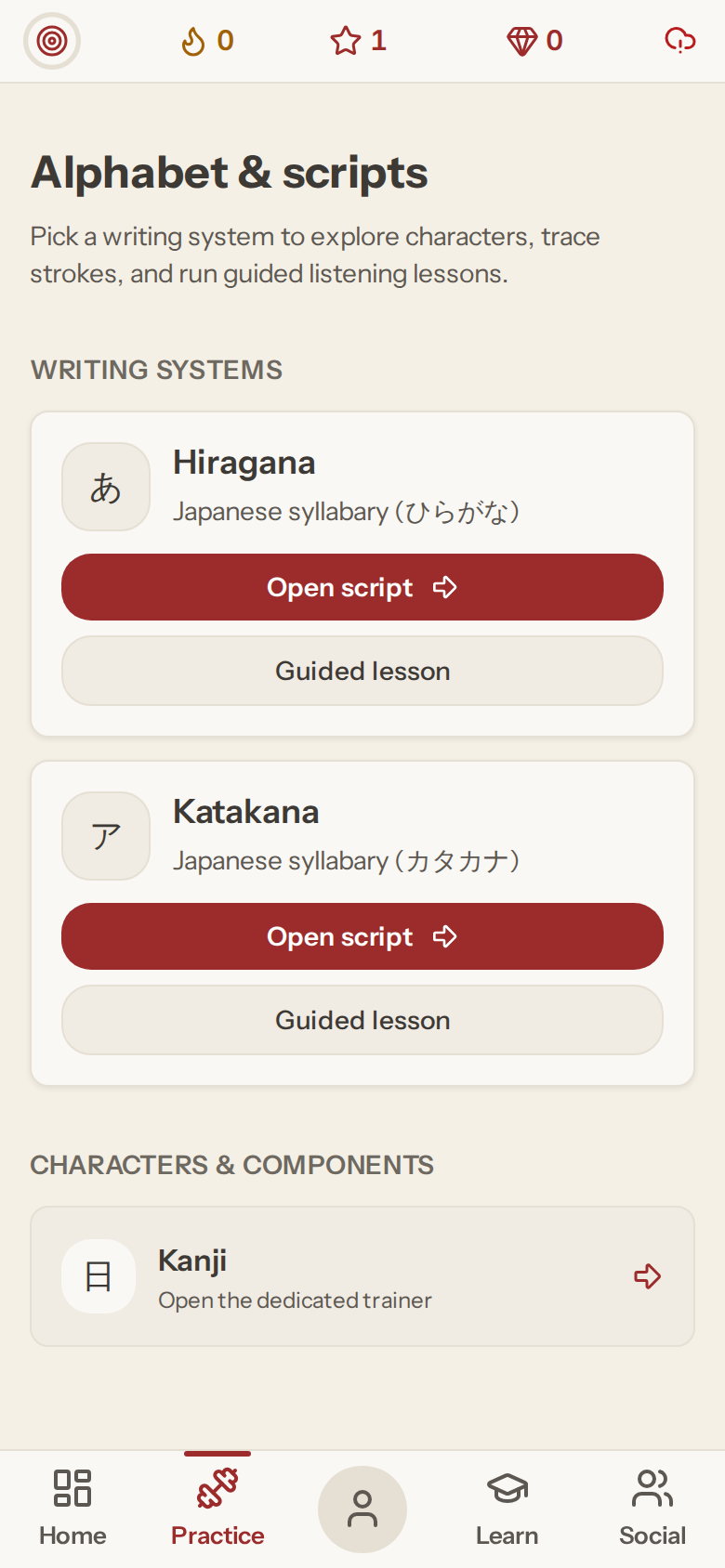
The courses teach the script in their first lessons too, so you do not have to finish letter practice before you start. It is there for extra practice and for review.
The script chart #
The chart groups characters into sections, such as the あ-row and か-row for kana, or plain consonants, basic vowels and compound vowels for Hangul. Each section has Learn this section and Test out of this section, and the top of the page lets you start from the beginning or test out of the whole alphabet.
Guided lessons #
Each character goes through the same four steps:
- Meet it: watch the animated stroke order and hear the sound.
- Trace it: draw over the template while you say the sound aloud.
- Recognize it: hear the sound and pick the matching character.
- Write it: hear the sound and draw the character from memory.
If you need several tries to write a character from memory, it comes back at the end of the lesson for another go. Kana sections built from characters you already know, such as the voiced sounds (が, ぱ) and combinations like りゃ, skip the drawing steps and focus on sound and recognition.
Stroke order #
Every kana and Hangul character has an animated stroke-order guide, and you can replay it while you draw. Stroke order is worth learning early: it makes handwriting legible and makes characters easier to recall.
Drawing #
When you check a drawing, the app compares the shape you drew with the template. It needs to cover enough of the character without wandering too far outside it. It does not check the order or direction of your strokes, so follow the animation for those.
Testing out #
A test-out is recognition only: hear a sound and pick the character. Pass a section to mark it done, or test out of the full alphabet if you can already read it.