I speak: English

Japanese writing

Hiragana, katakana and kanji: how Japanese is written

Japanese mixes three scripts in one sentence. Hiragana spells grammar and native words, katakana spells loanwords and emphasis, and kanji carry the meaning of most nouns and verb stems. In 私はコーヒーを飲みます ("I drink coffee") you can see all three. Start with the two kana: they are small, regular and learnable in a few weeks.

basic hiragana and katakana
46 + 46
jōyō kanji taught in Japanese schools
2,136
per kana, with very few exceptions
1 sound
kana simplified from kanji
8th–10th c.

Learn in this order

  1. あいうHiragana1–2 weeks · 46 + marksChart · Sheets
  2. アイウKatakana1–2 weeks · same soundsChart · Sheets
  3. 日人山First 100 kanji6–8 weeks · with vocabularyPlanned · Roadmap
  4. はじめての本Graded readingongoing · short storiesStories

Times assume about 15 to 20 minutes a day and are rough; your pace will differ. Learn each kana with its sound, then read real words with it the same day.

The first six rows

The first 6 rows of hiragana, each with its katakana twin and romaji
aiueo
–あアaいイiうウuえエeおオo
kかカkaきキkiくクkuけケkeこコko
sさサsaしシshiすスsuせセseそソso
tたタtaちチchiつツtsuてテteとトto
nなナnaにニniぬヌnuねネneのノno
hはハhaひヒhiふフfuへヘheほホho

Read across for the vowel and down for the consonant. Hiragana is large; its katakana twin sits beside it. Every character opens its own page with stroke order and audio.

Four sounds break the pattern. They are marked in red: し ち つ ふ are shi, chi, tsu, fu, not si, ti, tu, hu.

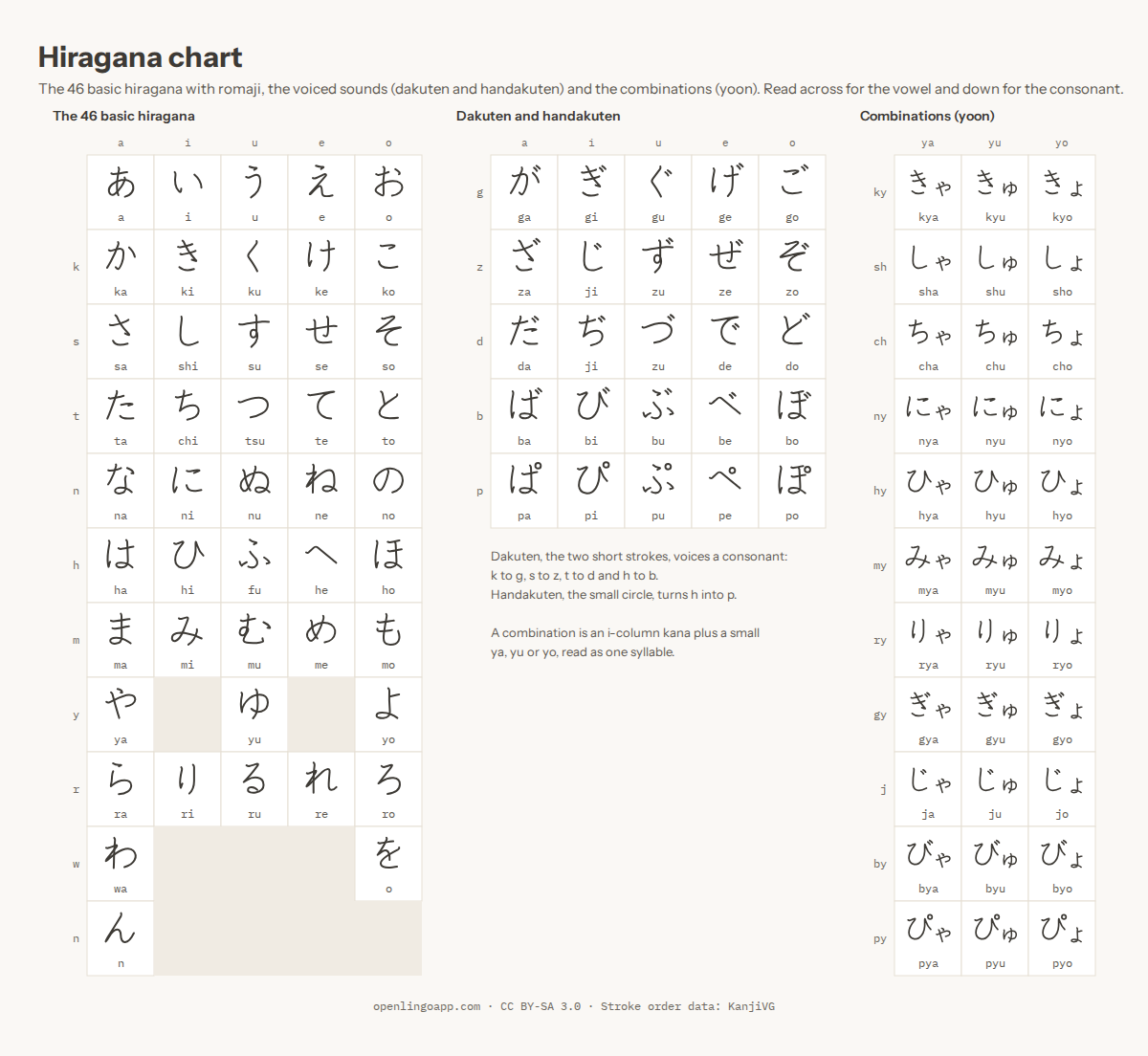
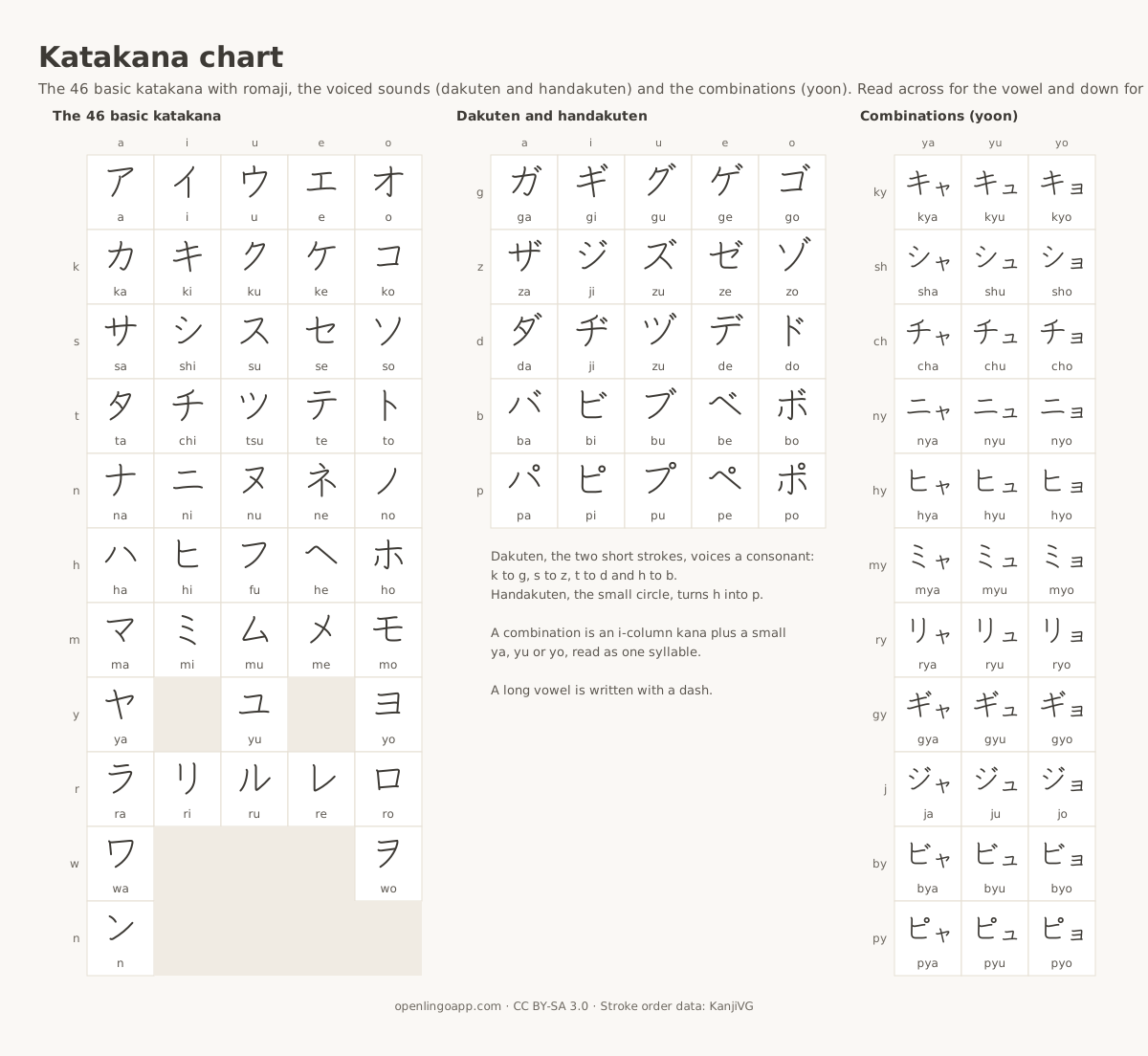
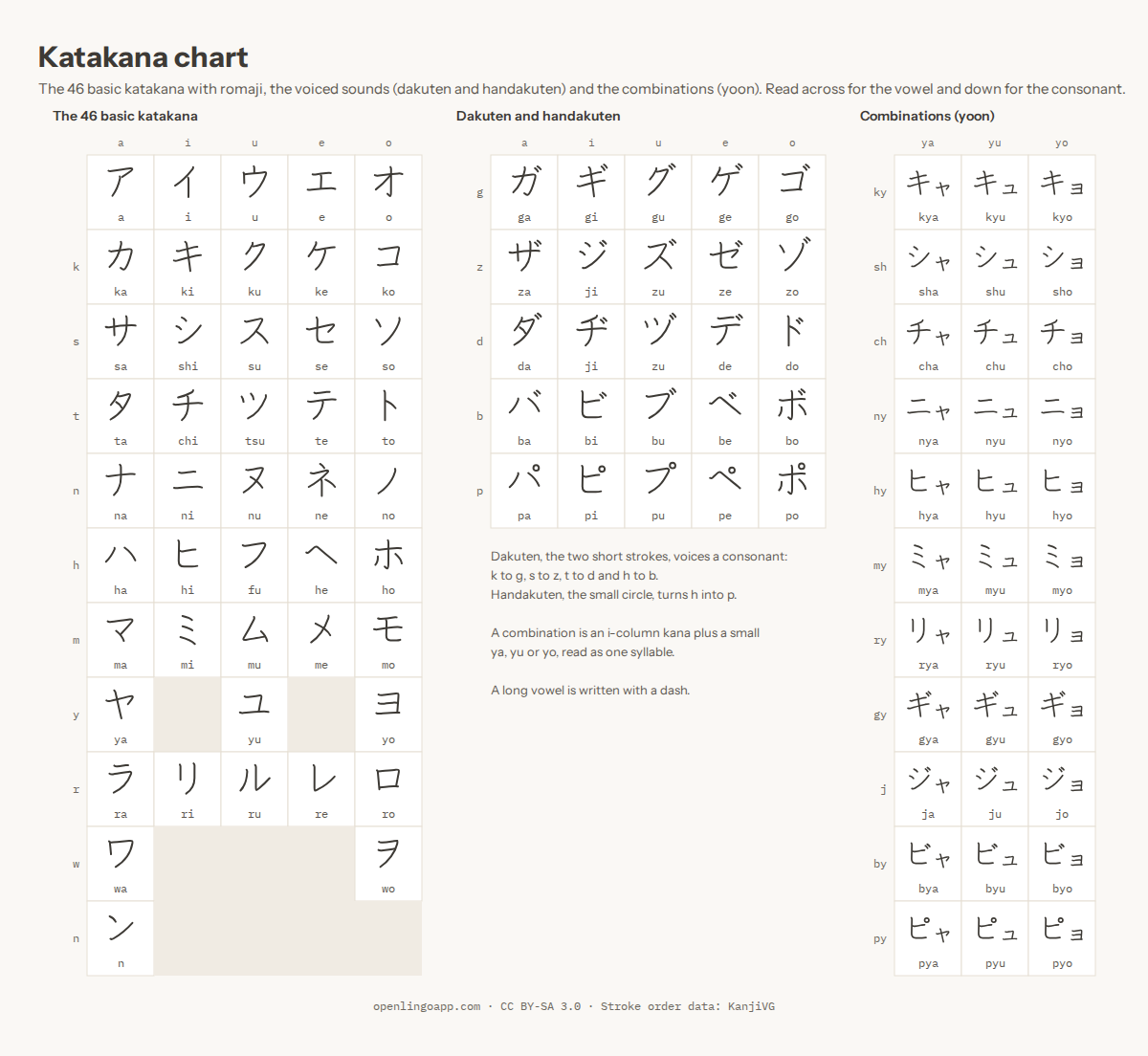
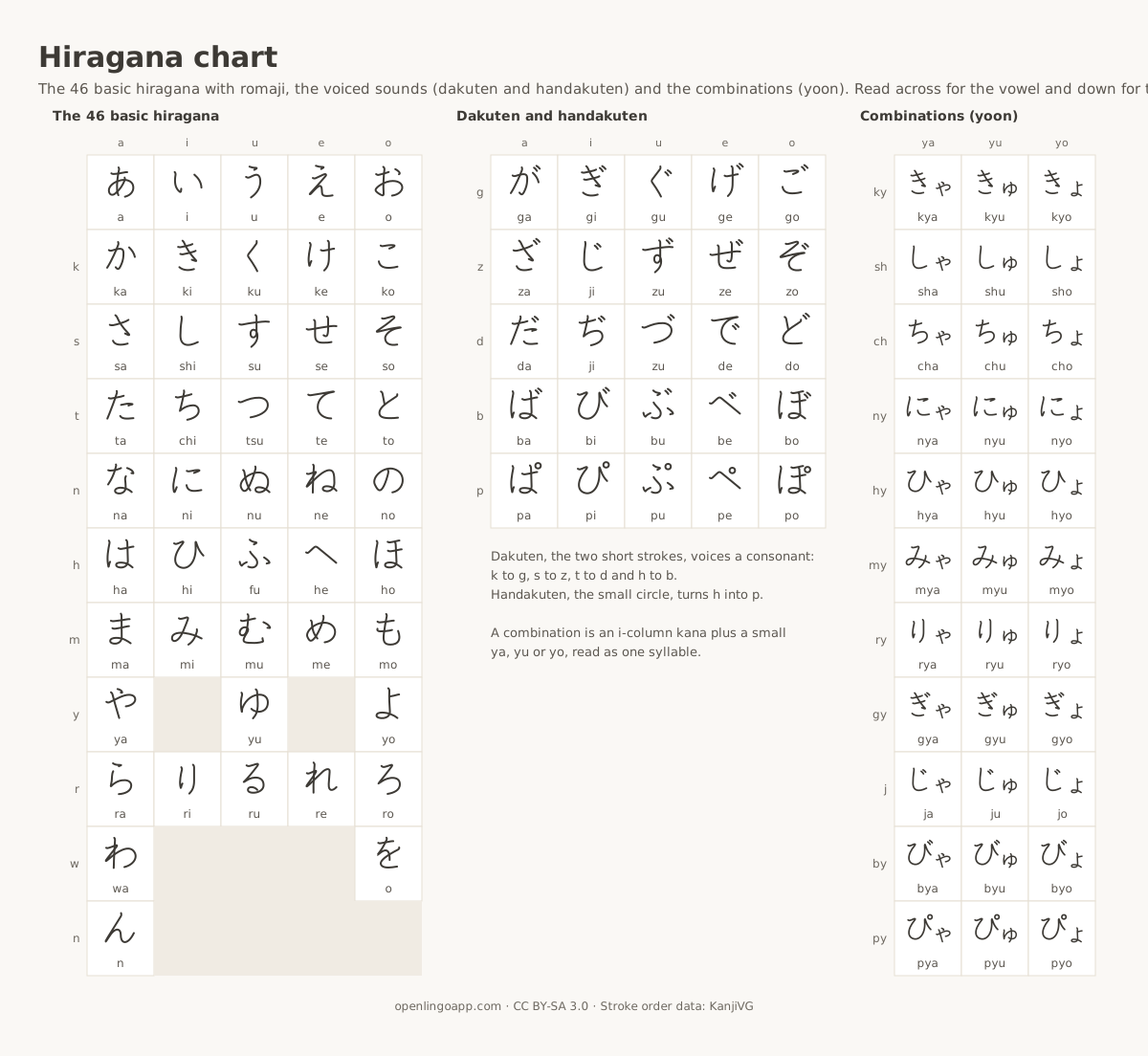
Full hiragana chart, with dakutenFull katakana chart

Print and practise

  • Hiragana chart with all 46 basic characters and romaji, plus the dakuten and combination (yoon) sounds

    Hiragana wall chart

    All 46 with dakuten and combinations, one page
    PNGSVGChart page

  • Katakana chart with all 46 basic characters and romaji, plus the dakuten and combination (yoon) sounds

    Katakana wall chart

    The same layout, so the two hang side by side

    PNGSVGChart page

  • Hiragana practice · あ rowTrace the grey characters, then fill the empty squares.NameDatea3 strokes. like 'a' in 'father'i2 strokes. like 'ee' in 'see'u2 strokes. like 'oo' in 'food', lips unroundede2 strokes. like 'e' in 'bed'o3 strokes. like 'o' in 'or'From memory · write each sound without lookingaiueoaiueoOpen Lingo · openlingoapp.com/learn/japanese/hiragana/worksheetCC BY-SA 3.0 · stroke order: KanjiVG (Ulrich Apel)

    Hiragana tracing sheets

    One per row, with stroke order; A4 or Letter

    Choose a row

  • Katakana practice · ア rowTrace the grey characters, then fill the empty squares.NameDatea2 strokes. like 'a' in 'father'i2 strokes. like 'ee' in 'see'u3 strokes. like 'oo' in 'food'e3 strokes. like 'e' in 'egg'o3 strokes. like 'o' in 'more'From memory · write each sound without lookingaiueoaiueoOpen Lingo · openlingoapp.com/learn/japanese/katakana/worksheetCC BY-SA 3.0 · stroke order: KanjiVG (Ulrich Apel)

    Katakana tracing sheets

    The same sheet for katakana
    Choose a row

All printables are free to copy for personal and classroom use (CC BY-SA 3.0). Stroke order from KanjiVG by Ulrich Apel.

Where the scripts came from

Chart of hiragana beside the cursive kanji each one came from, such as 安 to あ and 以 to い
Each hiragana beside the cursive kanji it came from. Hiragana origin, CC BY 2.5, via Wikimedia Commons.

From 安 to あ: how hiragana grew out of cursive kanji

Scribes borrowed kanji for their sounds alone, then wrote them faster and looser until 安 became あ and 以 became い. Read the article

Chart of katakana beside the kanji fragment each one was taken from, such as 阿 to ア and 伊 to イ
Each katakana beside the piece of kanji it was cut from. Katakana origine, CC BY-SA 3.0, via Wikimedia Commons.

Katakana began as a reader's shorthand

Students reading Chinese texts marked the pronunciation between the lines with fragments of kanji: 阿 gave ア, 伊 gave イ.